We supply two chemically different types of Dyne Test Inks or Dyne Test Fluids, both covering the full surface energy range from 23 to 72 mN/m. The right choice for you depends on health and safety considerations, material compatibility, and accuracy.
Type 1 – ISO Type Dyne Test Inks
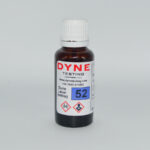 These inks are formulated to comply with ISO 8296: Plastics – Film and sheeting – Determination of wetting tension, the internationally recognised method for determining the wetting tension of plastic films and sheets.
We manufacture these in compliance with, and matching the chemistry specified in the ISO 8296 method; the formulations are based on 2-ethoxyethanol, formamide, methanol, and a purple dye. They are designed for accuracy and repeatability against the ISO method.
We do not recommend the use of this test fluid on soft PVC plastics, because the chemical can interact with the plasticisers and give an inaccurate result.
The ISO Type Dyne Test Inks are purple in colour. As well as being available in 20ml bottles, we supply these in inks in Dyne Test Pens.
Type 2 – Non-Toxic Type Dyne Test Inks
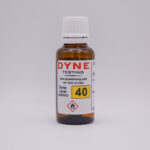 These inks are designed to reduce handling hazards while still allowing surface energy checks across the same dyne range. They are ethanol-based, blended with water or other alcohols to achieve target surface tension levels. Some customers prefer the lower hazard profile, perhaps in locations where chemical exposure controls are more restrictive.
Non-Toxic Type Dyne Test Inks are not recommended for use on polypropylene (PP). On PP, the chemical interaction can produce misleading wetting behaviour, meaning the apparent dyne value should not be trusted.
The Non-Toxic Type Dyne Test Inks are yellow. They are only available in 20ml bottles, as they are not compatible to being packaged in pens.
Colour and visibility
The ISO Type inks are purple, while the Non-Toxic Type inks are yellow. In practice, the purple ink is often easier to see on many substrates, while the yellow ink can be harder to read under some lighting conditions. However, colour does not affect the effectiveness or accuracy of the test. Measurement validity depends on the chemistry of the ink and its compatibility with the substrate, not the dye colour. Colour mainly affects confidence in visual interpretation.
Health & safety and safe use
Always read the Safety Data Sheet and carry out your risk assessment before using any of our Dyne Test Inks; the hazards and controls depend on the formulation.
Both ink types can be used safely in normal industrial environments when the SDS is followed, a risk assessment is carried out, and appropriate PPE and ventilation are provided.
Our ISO Type Dyne Test Inks are solvent-based and typically contain methanol and glycol ethers, making them flammable and toxic if swallowed, inhaled, or absorbed through the skin, with potential for serious health effects from even short-term exposure. They therefore require controlled handling, good ventilation, appropriate PPE, and careful storage and disposal, even though they are supplied in very small 20g bottles or pen formats. Our Non-Toxic Type Dyne Test Inks have a lower health hazard profile, with reduced toxicity and fewer long-term health concerns, which is why some organisations prefer them from an H&S perspective, but they are still flammable liquids and still require sensible precautions. In both cases, the small quantities supplied reduce the scale of potential exposure, but they do not remove the need for proper chemical handling, and compliance with site H&S rules.
Choosing between ISO Type and Non-Toxic Type Dyne Test Inks
Use ISO Type inks when:
- You need alignment with ISO 8296
- You are testing materials compatible with the formulation
- Your H&S framework allows their use
Use Non-Toxic Type inks when:
- H&S restrictions rule out formamide or glycol ethers
- You are working with materials other than PP
- A lower hazard solution is required for routine checks
Accuracy and measurement validity
Accuracy matters in testing with dyne inks or dyne fluids because the result is inferred from wetting behaviour, not directly measured, and that inference only holds when the test fluid behaves as the method assumes. The chemistry of the ink controls evaporation, polarity, and how it interacts with the surface, which is why ISO 8296 tightly defines the solvent mixture. When a fluid chemically interacts with a substrate rather than simply wetting it, as with ISO Type inks on soft PVC or ethanol-based inks on polypropylene, the liquid can spread for reasons unrelated to surface energy. The test still looks convincing, but the number is wrong. In practical terms, that means a surface can appear ready for bonding, printing, or coating when it is not, creating hidden process risk. Choosing the correct dyne ink is therefore about measurement validity as much as safety or convenience.