Measuring cleanliness is like measuring silence – you can’t. But you can measure noise. In the same way, you can’t measure cleanliness, but you can measure contamination.
There are several ways of measuring or assessing contamination on metal, including contact angle measurement, various forms of spectroscopy (FTIR, XPS) and gravimetric analysis, which for this purpose involves washing the sample in solvent and weighing it before and after.
Conveniently, organic contamination such as oils, grease, cleaning fluids and release agents fluoresce under UV light. This is due to electrons being excited, then losing some energy and finally returning to the ground state, which gives off a photon of a lower wavelength. Metals do not fluoresce under UV light. So, when UV light is shone onto a metal part, any organic contamination on the surface is detectable by the fluorescence.
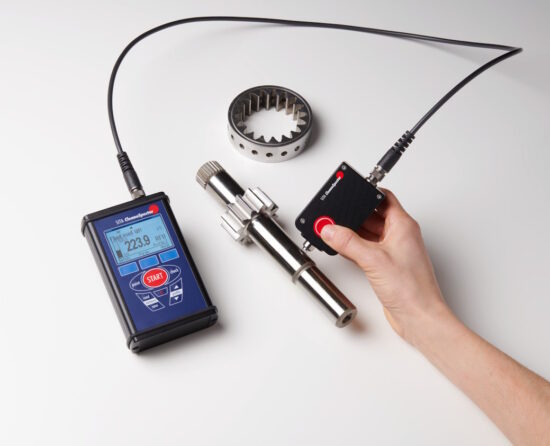
The CleanoSpector is an instrument which measures this fluorescence and converts the photons counted into a value, defined as Relative Fluorescence Units (RFU).
Using a CleanoSpector, RFU measurements are a quick and easy way to assess organic contamination on a metal surface, and can reliably give you an insight into your cleaning process and part cleanliness. It is a handheld device, non-contact and non-destructive, which gives results at the push of button
Like the name suggests, RFU is a relative thing. An RFU of 50 is cleaner than an RFU of 100. Measuring an absolute cleanliness value is much more complicated, and probably not necessary for many process control and QA assessments.
“But how do I know my part is clean enough?” Well, that is something you will have to determine yourself in your own unique process. Surfaces and materials and processes vary – some are more robust, some are more sensitive. Is an RFU of 300 clean enough for my paint to adhere? Is an RFU of 25 too high to prevent adhesive failure? Only you can assess that.
By testing a surface which is clean enough and recording the RFU level, you establish a baseline of an acceptable surface cleanliness (with a tolerance). You can then compare the RFU test results in goods in or after a cleaning process for a comparable measurement. Is my RFU within my acceptable tolerance levels? Good to go. Is my RFU higher than yesterday? What has changed?
So, if flaking paint or weak bonds are causing you headaches, get in touch to arrange a demonstration to find out if your surfaces are as clean today as they need to be.