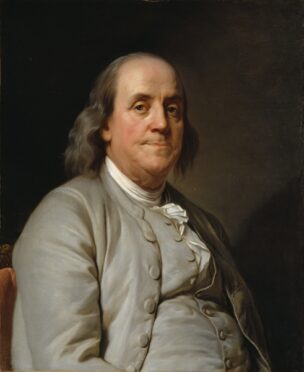
 In 1774, Benjamin Franklin did something quietly brilliant. Standing beside a blustery pond on Clapham Common in London, he poured some oil (reportedly from his cane) onto the water. Within moments, ripples vanished. A choppy surface turned mirror-smooth. It was one of the earliest recorded observations of surface tension.
Franklin wasn’t thinking about surface tension – that term didn’t exist yet – but he was watching it in action. He wrote to the Royal Society that “a teaspoonful of oil produced an instant calm over a space several yards square… spreading until it reached the lee side, making that quarter of the pond as smooth as a looking glass.” It was, in modern language, an early field test in interfacial and surface science.
Why does this story still matter? Because the same invisible forces that fascinated Franklin underpin how adhesives wet a substrate and develop adhesion, or a hydrophilic or hydrophobic coating wet a catheter, or how your surfactant helps with precision cleaning. The quiet physics at the water’s surface are alive in every drop of adhesive, coating, ink, flux or cleaning chemistry that you use.
We like Franklin’s mix of curiosity and practicality. He didn’t have a force tensiometer or a bubble pressure tensiometer, but he had questions – and he ran the experiment. That’s the spirit we celebrate: incurably curious and a natural disposition to sharing knowledge.
A few centuries later, we’ve swapped oil and ponds for ultra-sensitive electromagnetic balances for measuring surface tension and precision-dispensed droplets for quantifying contact angles, but the curiosity is the same. Franklin would approve.