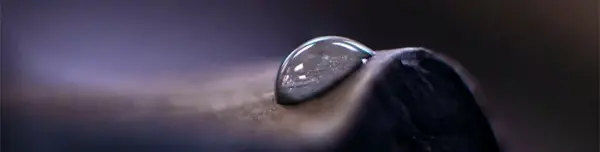
Water contact angle (WCA) describes the shape a droplet of water forms when placed on a surface. If the water spreads out, the water contact angle is low. If it beads up, the water contact angle is high.
This matters because the way a liquid wets a surface strongly affects processes such as adhesive bonding, coating, printing, and sealing. In general, low contact angles indicate a cleaner, higher-energy surface that is easier to bond to. High contact angles suggest a lower-energy or contaminated surface where adhesion may be less reliable.
Water contact angle measurement is widely used as a quick way to assess surface condition and bond readiness. A small droplet of ultra-pure water is applied to the surface and the angle is measured using a dedicated instrument. The test only takes seconds but can reveal problems caused by oils, handling contamination, mould release agents, oxidation, or poor surface treatment.
Why water?
Water is used because it is highly sensitive to surface condition and surface energy. Its strong polarity means it reacts noticeably to even small amounts of contamination, oxidation, or poor surface treatment. On a clean, high-energy surface, water spreads out easily. On a contaminated or low-energy surface, it beads up. That makes it an excellent indicator of whether a surface is likely to bond, coat, or print successfully.
There are other test liquids, and in laboratory environments manufacturers may use several liquids to calculate detailed surface energy values. But water is fast, safe, inexpensive, consistent, and highly practical for routine process control and production testing.
We can help you use water contact angle testing to verify cleaning processes, evaluate plasma treatment effectiveness, investigate adhesion failures, and improve process consistency. For example, Brighton Science’s Handheld Surface Analyst delivers fast, precise, and repeatable water contact angle measurements, empowering you to verify surface conditions before critical production steps